



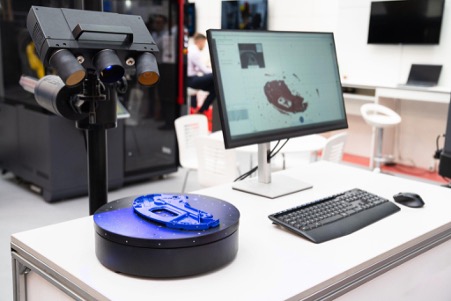
Laser Machine Vision: Precision & 3D Scanning
Lasers are playing an increasingly important role in machine vision systems, enhancing precision, accuracy, and efficiency in industrial and research applications. From 3D scanning and inspection to automated quality control, laser-based vision technologies are reshaping how businesses achieve consistency and speed in manufacturing processes. High-power diode lasers provide stable light sources that enable detailed imaging, advanced measurement capabilities, and reliable performance across various industries.
In this article, we explain how lasers are transforming machine vision, the benefits they bring to industrial automation, and why selecting the right laser module is key to achieving next-level accuracy and productivity.
Introduction
Machine vision systems are essential for industries that rely on automation, quality inspection, and precise measurement. To achieve accurate results, these systems require reliable and consistent light sources. Diode laser modules have become a leading choice due to their ability to deliver stable, controlled illumination that supports advanced imaging and scanning.
By integrating diode lasers into vision systems, manufacturers gain tools that help improve efficiency, reduce errors, and increase product quality.
How Lasers Improve Machine Vision
1. Precision Illumination
Lasers provide a focused, monochromatic light source, which improves contrast and accuracy in imaging. Unlike traditional LEDs or other lighting methods, lasers minimize noise and enable machine vision systems to capture high-resolution images consistently.
A key advantage is wavelength selectivity. By selecting the optimal wavelength for their diode laser module, manufacturers can minimize spectral overlap and enhance image contrast, which is particularly important in industrial applications where detecting defects and verifying part accuracy are crucial.
While lasers can introduce speckle noise, many machine vision systems overcome this issue with the use of beam diffusers, beam shaping optics, and various scanning methods to ensure smooth and reliable illumination.
2. 3D Scanning and Depth Sensing
In industrial applications, diode lasers are used in structured light and time-of-flight systems to generate accurate 3D models. This is critical in robotics, assembly lines, and automated quality inspection.
- Structured light: projects laser patterns that capture physical surface distortions.
- Triangulation: measuring object geometry by measuring the angle of reflected laser light.
- Time-of-flight: uses laser pulses to calculate distances.
3. High-Speed Inspection
Lasers enable faster scanning speeds compared to conventional lighting methods. Their high coherence enables machine vision systems to capture high-resolution images, thanks to the laser source’s high predictability. This enables vision systems to inspect products in real-time without slowing down production lines.
4. Reliable in Harsh Environments
Diode laser modules are compact, energy-efficient, and durable, making them ideal for challenging industrial environments where traditional lighting may be unreliable.
- High-temperature production floors: diode laser modules are cooled to maintain stable output under thermal stress
- Dusty or high vibration environments: compact laser modules can be ruggedized for long-term use
Applications of Laser-Based Machine Vision
- Manufacturing & Quality Control – Detecting defects in automotive components, verifying assembly alignment, and ensuring accurate part measurements.
- Robotics & Automation – Providing real-time depth and spatial data for robotic arms, automated guided vehicles, and collaborative robots.
- Electronics – Inspecting printed circuit boards and micro-components with high precision.
- Medical Device Production – Assisting in detailed inspections of small and sensitive components such as stents, catheters, and micro-surgical instruments, where precision is non-negotiable.
- Research & Development – Supporting advanced imaging and analysis in fields such as material science, optics, and biotechnology.
Benefits of Using Diode Lasers in Vision Systems
- Consistency – Stable output ensures repeatable imaging results, necessary for automated quality control.
- Compact size – Small form factors facilitate straightforward integration into robotic arms, handheld scanners, and compact inspection stations.
- Customizable wavelengths – Tailored solutions for specific wavelengths can be chosen to match specific imaging requirements.
- Energy efficiency – Reduced operating costs compared to other light sources.
- Long lifetime – Durability reduces downtime and maintenance costs, making diode lasers a cost-effective choice.
The Role of Custom Laser Modules
Different industries have unique requirements for machine vision. Choosing the right laser wavelength, power level, and packaging is crucial for performance. Akela Laser offers high-power laser diodes and single-wavelength modules that can be tailored for machine vision applications.
With advanced engineering and manufacturing expertise, Akela Laser supports OEMs and system developers in designing reliable, application-specific solutions. To discuss a project, visit the contact page.
Future Outlook
As automation and artificial intelligence continue to advance, the demand for high-accuracy machine vision systems is expected to increase. The combination of laser illumination with AI-driven analysis will enable smart defect detection, adaptive robotics, and predictive quality control.
Emerging areas include:
- Hyperspectral laser imaging for material identification in recycling and food safety
- Multi-wavelength laser modules for advanced medical imaging
- EV battery inspection and semiconductor fabrication, where high precision is required
Conclusion
Lasers are transforming machine vision systems by providing the precision, consistency, and adaptability required for modern automation. From quality control in manufacturing to advanced robotics and research applications, high-power diode lasers deliver performance that conventional light sources cannot match.
For businesses seeking reliable laser modules tailored to their machine vision needs, Akela Laser offers engineering expertise and customized solutions.
FAQs
1. Why are lasers used in machine vision instead of traditional lighting?
Lasers provide stable, monochromatic light that reduces noise and increases accuracy compared to conventional lighting sources.
2. What role do diode lasers play in 3D scanning?
They project structured light patterns or pulses that allow vision systems to capture accurate depth and dimensional data.
3. Are diode lasers energy-efficient for industrial applications?
Yes, they consume less energy than many traditional light sources while delivering high power and long lifetimes.
4. Can diode lasers be customized for machine vision systems?
Yes, manufacturers like Akela Laser provide modules with specific wavelengths and power outputs tailored for OEM requirements.
5. What industries benefit most from laser-based vision systems?
Manufacturing, electronics, robotics, medical device production, and research sectors use lasers for precise imaging and inspection.