



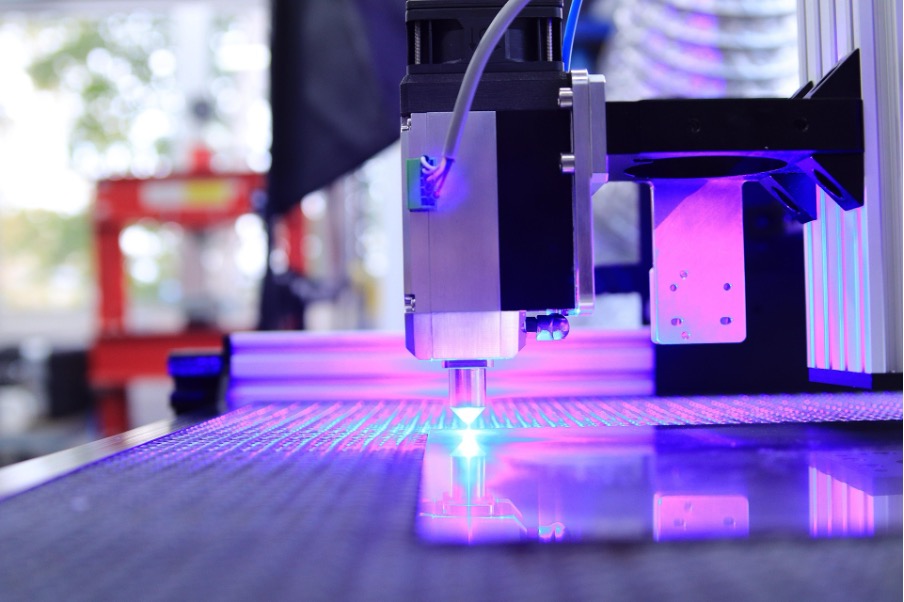
Industrial Laser Wavelength Guide for Applications
Industrial lasers have become essential tools across manufacturing, materials processing, and scientific research due to a wide variety of available wavelengths. Each wavelength interacts differently with material, affecting absorption, beam penetration depth, and thermal response, making it crucial to choose the right laser source for the job. Modern laser systems provide unmatched flexibility for applications like cutting, welding, engraving, and surface treatment. For industrial processes, high-power laser diodes, multi-wavelength modules, and single-wavelength lasers are commonly tailored to the specific material requirements, improving precision, efficiency, and long-term reliability.
Why Wavelength Matters in Industrial Lasers
The wavelength of a laser determines how its light is absorbed, reflected, or transmitted by different materials. For example, metals, polymers, ceramics, composites, and semiconductors all demonstrate wavelength-dependent absorption characteristics. Choosing the right wavelength for laser material processing enhances efficiency, minimizes damage, and improves product quality.
Key Factors Influenced by Wavelength:
- Absorption coefficient of the target material
- Optical penetration depth
- Heat distribution
- Cutting/marking speed
- Surface reflectivity
Common Wavelengths in Industrial Lasers
1. Ultraviolet (UV) Lasers (200–400 nm)
Best for: Microelectronics, medical device manufacturing, and precision marking.
Benefit: Shorter wavelengths produce shallower absorption depths and leverage higher photon energies, significantly reducing the heat-affected area compared to longer wavelengths.
Typical Sources: Excimer lasers, frequency-doubled solid-state lasers, and diode lasers.
2. Visible Lasers (400–700 nm)
Best for: Alignment, inspection, specialty micromachining, and certain polymers.
Benefit: Highly absorbed by plastics and organic materials. Absorption varies widely depending on pigmentation and molecular composition. Clear materials transmit strongly, and pigmented materials may absorb more strongly in this range.
Typical Sources: Diode lasers, legacy argon-ion lasers.
3. Near-Infrared (NIR) Lasers (700–1400 nm)
Best for: Metal cutting, welding, brazing, and additive manufacturing.
Benefit: High-power laser diodes are widely used for metal processing, plastic welding, surface heat treatment, and pump sources.
Typical Sources: High-power diode lasers, fiber, and disk lasers
4. Mid-Infrared Lasers (1400–5000 nm)
Best for: Non-metallic materials like polymers, glass, medical materials, and composites.
Benefit: These wavelengths align with strong vibrational absorption bands in non-metallic materials
Typical Sources: Diode lasers, Thulium, and Holmium solid-state sources.
5. Long-Wave Infrared (Far-IR) Lasers (~10.6𝛍m)
Best for: Plastics, wood, textile, glass, ceramic, and other organic materials.
Example: CO2 lasers operating at this wavelength are commonly used due to strong absorption of organic compounds and many polymers
6. Multi-Wavelength Laser Modules
Best for: Industrial environments that require processing multiple material types. Multi-wavelength modules allow manufacturers to optimize performance without incurring excessive downtime from equipment swaps.
Example: Multi-Wavelength Laser Diode Modules can combine beams for simultaneous processing tasks.
Industrial Applications by Wavelength
| Wavelength Range | Typical Lasers | Industrial Applications |
| 200–400 nm (UV) | Excimer, UV Diodes | Semiconductor patterning, precision marking |
| 400–700 nm (Visible) | Diode, Argon | Plastic welding, medical devices |
| 700–1400 nm (NIR) | Fiber, Diode, YAG | Metal cutting, welding, and additive manufacturing |
| 1400–5000 nm (Mid-IR) | High-Power Diode | Plastic engraving, glass cutting, ceramics |
| ~10.6 𝜇m (Far-IR) | CO₂ | Polymer, glass, and organic material cutting and engraving |
| Multi-Wavelength | Custom Diode Modules | Multi-material processing, research |
Role of High-Power Laser Diodes
High-Power Laser Diodes are a cornerstone of industrial laser systems because they:
- Deliver concentrated energy for deep penetration in metals.
- Serve as pump sources for fiber and solid-state lasers.
- Offer high electrical to optical efficiency.
- Can be configured as single-wavelength modules for precision or multi-wavelength modules for flexibility.
- Offer scalability for applications ranging from small-scale fabrication to heavy industrial production.
Partnering with a Laser Diodes Manufacturer ensures access to reliable, wavelength-specific modules with high thermal stability and proven optical performance.
The Future of Wavelength Engineering in Industry
Emerging trends include:
- Custom diode modules with tunable wavelengths.
- AI-optimized wavelength selection for adaptive manufacturing.
- Hybrid laser systems combining multiple wavelengths for complex material processing.
These innovations will further expand the role of lasers in precision manufacturing, energy efficiency, and next-generation industrial automation.
FAQs
- Why do industrial lasers use different wavelengths?
Different materials absorb light differently, so wavelength selection ensures optimal cutting, welding, or marking results. - What wavelength is best for cutting metals?
Near-infrared lasers (800–1100 nm) are most effective for metal cutting due to high absorption. - Are UV lasers used in heavy industry?
Not typically — UV lasers are best for microelectronics and delicate materials, not large-scale metal processing. - What are the benefits of Multi-Wavelength Laser Diode Modules?
They provide flexibility, allowing a single system to process multiple material types without swapping equipment. - Why source from a Laser Diodes Manufacturer in the USA?
U.S. manufacturers ensure high-quality engineering, strict testing standards, and reliable supply chains for industrial-grade systems.